
How to Search Civil Dockets
The search starts with the correct clerk. Lonna Henderson, Circuit Court Clerk, handles Circuit and General Sessions Civil matters. Paige Mashburn, Clerk and Master, keeps Chancery records. Probate, estates, trusts, guardianships, and conservatorships sit there too. For a first routing aid, use the county's official services page.
Gather the details before you call or visit. Bring the full party or business name, the court, the filing year, a rough date, and the case type. Include the exact case number if you have it. For an older matter with no number, narrow the request by court and date range. Then follow these steps:
- Classify the claim as Circuit, General Sessions Civil, Chancery, probate-related, appellate, or federal.
- Contact Henderson or Mashburn by phone, at the counter, by mail, or through an office-approved email route.
- Supply the narrow identifiers and ask whether the file is indexed or imaged.
- Read parties, roles, filing dates, motions, settings, orders, judgment, and status together.
- Request the specific pleading, order, judgment, or certified copy if the docket summary is not enough.
Appeals and federal cases follow different paths. The broader Marion County case search explains when an appeal moves to Public Case History and when a federal civil case belongs in PACER.
Marion Civil Routing Splits
The civil label alone will not tell you which office holds the file. Marion County Circuit Court takes the major civil actions. Those include damages, contract and tort disputes, foreign judgments, wrongful death, malpractice, condemnation, name changes, and appeals. General Sessions covers recovery warrants, detainers, and orders of protection. Chancery Court handles equity. It also takes a wide mix of domestic, estate, trust, tax, lien, boundary, and business matters.
| Route | Examples from Marion services | Starting clerk |
|---|---|---|
| Circuit Court | Damages, contract, tort, foreign judgment, condemnation, appeal | Lonna Henderson |
| General Sessions Civil | Recovery warrant, detainer, protection-order process | Lonna Henderson |
| Chancery Court | Equity, estate, trust, tax lien, boundary, dissolution | Paige Mashburn |
Domestic relations and workers compensation show up in more than one county service description. That overlap is a reason to ask the clerk. A category list alone should not drive a venue decision.
What a Civil Docket Shows
Think of a Marion County civil docket as the index to a case file. It names the court and the case. It then traces the claim from filing through service, motions, settings, orders, judgment, and any appeal. For trial-court classifications, the AOC civil reporting manual is the reference. Tennessee Public Case History offers a helpful appellate model. But it cannot replace the local trial record.
| Case number | The local locator; preserve the clerk's exact punctuation and year in the recorded format. |
|---|---|
| Style and roles | The case caption and plaintiff, defendant, petitioner, or respondent roles. |
| Filings | Complaint, petition, answer, service return, motion, exhibit, or other entry. |
| Settings | Hearing, mediation, motion, or trial date with judge and location when shown. |
| Orders and judgment | Entries marking rulings, dismissal, final judgment, or later enforcement work. |
| Status and appeal | Pending, closed, transferred, or appealed status and any cross-reference. |
An appellate document-history row sometimes offers a PDF. A local entry saying an order was filed guarantees nothing about a free image. For the signed order, ask the custodian.
Marion Chancery and Probate Channel
Chancery and probate work has its own Marion County civil docket route. That route runs through the Clerk and Master office led by Paige Mashburn. The county puts domestic relations, estates, trusts, guardianships and conservatorships, delinquent taxes, liens, boundaries, contracts, fraud, election contests, and partnership or corporate dissolution under Chancery functions. Current office contact details appear in the official AOC clerk profile.
Say exactly which record you need in the request. An estate inventory, a guardianship filing, a Chancery docket sheet, and a certified judgment are not interchangeable. Some sensitive personal information may be redacted. Certain protected material will not come out through an ordinary public request.
Use precise terms: Give the court, case number, party name, filing year, desired document, and date range. Ask whether inspection or a copy is available.
This split may be the single most important fact in a Marion County civil docket search. A Chancery request sent to the Circuit clerk can sit unanswered even with the right party name.
Types of Civil Cases on the Docket
Marion County civil dockets cover several court functions. Treat the county's service descriptions as routing aids, not legal advice on where a new claim must be filed. Existing paperwork usually names the court. If it does not, ask the clerks to locate the record before requesting copies.
- Contract, tort, auto and non-auto damages, wrongful-death, and malpractice matters
- Divorce, child support, adoption, and other listed domestic-relations matters
- Estates, trusts, guardianships, conservatorships, and related probate work
- Liens, delinquent taxes, boundaries, condemnation, and property-linked claims
- Recovery warrants, detainers, protection orders, appeals, and listed civil processes
A federal civil claim tied to a Marion County person or address is not automatically a county case. Check the caption. If it names the United States District Court for the Eastern District of Tennessee, use PACER and the federal clerk route.
Marion E-Filing Is Not Access
The 2023-24 Tennessee Judiciary Annual Report lists Marion Chancery as “Applied” for e-filing. That label shows progress. It does not mean every lawyer can file through one public route, that anyone can search every case, or that document images are free. Ask the clerk to confirm how filings and case inspections work right now. Tennessee Rule 5B makes electronic filing depend on an authorized system and local adoption, so the county's docket access still hinges on what the local court has actually put in place.
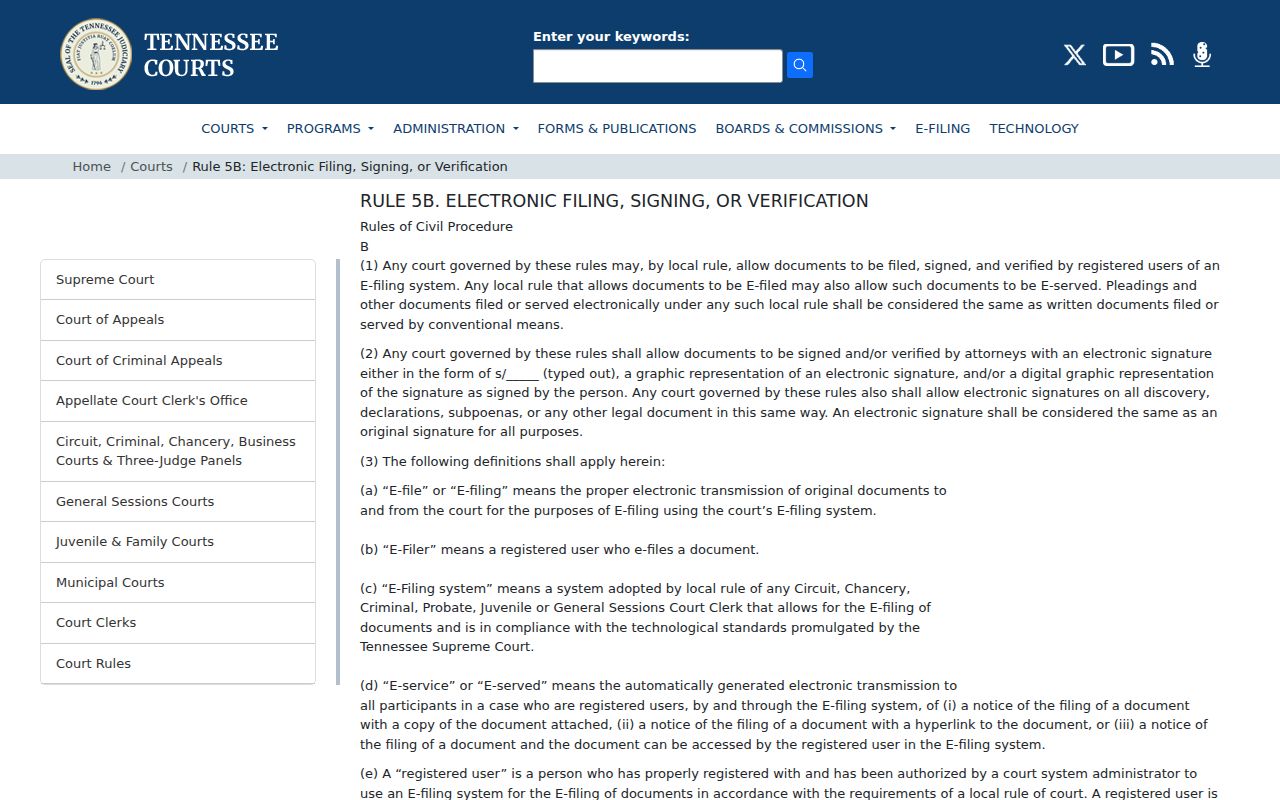
That official page draws the line between filing access and public viewing access. AOC TnCIS materials also describe clerk review and the marking or redaction of non-public images. A Marion County civil docket may name a filed document. The image may still be unavailable online.
Note: "Applied" e-filing status does not promise an open Marion civil docket or free copies of filed papers.
Settings and Hearings on Civil Dockets
A Marion County civil docket can carry motion hearings, scheduling events, mediation, trial settings, and rulings. A setting is not always the final trial. It just reserves a court event. A continuance shifts a setting to a new date. The case stays alive. A scheduling order can pile on several deadlines before any hearing shows up.
The county calendar covers government events rather than a verified judicial daily docket. Trust the case file instead. The notice or signed order controls, then confirm the current date with Henderson or Mashburn. Ask for the date, start time, court, judge, location, hearing type, and whether you must appear. When two dates conflict, ask the clerk which filed order governs.
- Setting
- A scheduled hearing or appearance slot.
- Continuance
- A postponement or reset, usually reflected by a later entry.
- Motion
- A party's request for a ruling before or during final disposition.
- Judgment
- The enforceable court decision, which should be read in its signed form.
Write down when the clerk confirmed the information. A current docket entry beats a general session pattern, though only the clerk can explain a last-minute change.
Older Marion Civil File Search
An old Marion County civil docket may never surface in an online index. Begin with the court named on any saved paper. Missing a case number? Give the clerk a party or business name, the likely filing year, the claim type, and a narrow date range. Ask whether the file sits on paper, microfilm, or an internal index. Ask whether you must inspect it at the counter.
A no-result screen is not a final answer. The matter may belong to Circuit rather than Chancery, carry a former party name, use different punctuation, predate any electronic index, be sealed in part, or live in federal court. Ask both local civil custodians only when the case type truly muddies the route.
Once you find the case, request the docket sheet first if the document you want is unknown. Its entry dates can point to the exact complaint, order, or judgment worth requesting. That keeps copy costs tight.
Certified Judgment or Docket Printout
A Marion County civil docket printout lays out the chain of events. A certified judgment is different. It is a clerk-authenticated copy of the court's actual filed decision. The two records serve different needs, so have the clerk classify a request before copying. "Order entered" is only a docket entry. It is no substitute for the order's full text.
| Record | What it answers | How to obtain it |
|---|---|---|
| Docket sheet | What was filed and when | Ask the responsible civil clerk |
| Ordinary document copy | What a pleading or order says | Identify the entry and page range |
| Certified judgment | Authenticated terms of the final ruling | Request certification from the custodian |
Ask for a fee estimate and the current payment method before ordering. State fee sources set the outer frame, but the clerk sets the local price, so no Marion web-image figure or guaranteed email delivery should be assumed.
Public Access to Civil Dockets
Tennessee law generally favors inspection of public records while honoring statutory and court-ordered limits. Tennessee Supreme Court Rule 34 sorts court records into categories and shields sealed records, judicial drafts, internal case-management material, and other confidential content. The Tennessee Public Records Act adds a request framework for citizens, subject to exceptions and custodian procedures.
Access boundaries:
Tenn. Code Ann. § 10-7-503 generally permits inspection during business hours, subject to lawful exceptions and reasonable rules.
Tenn. Code Ann. § 10-7-504 supplies confidentiality exceptions, so an open case does not make each filed item public.
Tenn. Code Ann. § 10-7-505 provides a court-review route for denied access after the request and denial are preserved.
If a Marion County civil docket looks incomplete, ask why. Any gap usually has a cause. Sealing, redaction, a missing image, an old unindexed file, or a portal limit can all leave gaps. Request only the non-confidential portion, and ask for the basis of any denial. Domestic, guardianship, estate, and protection-order records deserve extra care. Public entries and protected content can share one file.
Note: Public docket access has limits. It does not grant every image, private identifier, or protected filing in a Marion civil case.