
How to Search Criminal Dockets
Marion County posts no open web form for a Circuit or General Sessions criminal docket. Start with the official Marion County services map. It sorts out which court handles the charge. County and Tennessee Highway Patrol citations flow through Circuit and General Sessions. Misdemeanors, preliminary matters, and felony work land there too. Lonna Henderson, the Circuit Court Clerk, is the practical first contact for those records. A city ordinance or city traffic charge stays with the municipal clerk instead. A federal charge belongs to the Eastern District of Tennessee system.
Have the exact case number ready if you know it. Jot down the defendant's full name too. Add the filing year, charge type, issuing agency, and a rough hearing date. A common name alone may pull up the wrong matter. Then work this sequence:
- Identify the court from the citation, notice, bond paper, or prior docket entry.
- Contact the responsible clerk by phone, at the counter, by mail, or through an office-approved email route.
- Give narrow identifiers, then ask for the current docket and next setting.
- Review the court, charge, status, settings, disposition, and document entries together.
- Ask for the filed judgment or certified copy when the docket is not enough.
The Marion County case search overview sorts local, appellate, and federal routes. A blocked or blank screen does not mean no criminal case exists.
Marion Criminal Search Has Limits
Tennessee Case Finder and CourtNet advertise a public-inquiry system. It covers participating Circuit and General Sessions Civil offices. The interface stops at a login, though. It offers no open Marion County criminal docket field grid. Marion Circuit, General Sessions, and Juvenile offices use CourtNet internally for case management. That internal use does not put every criminal docket on the public web.
The restricted screen records an access barrier, not a public local search.
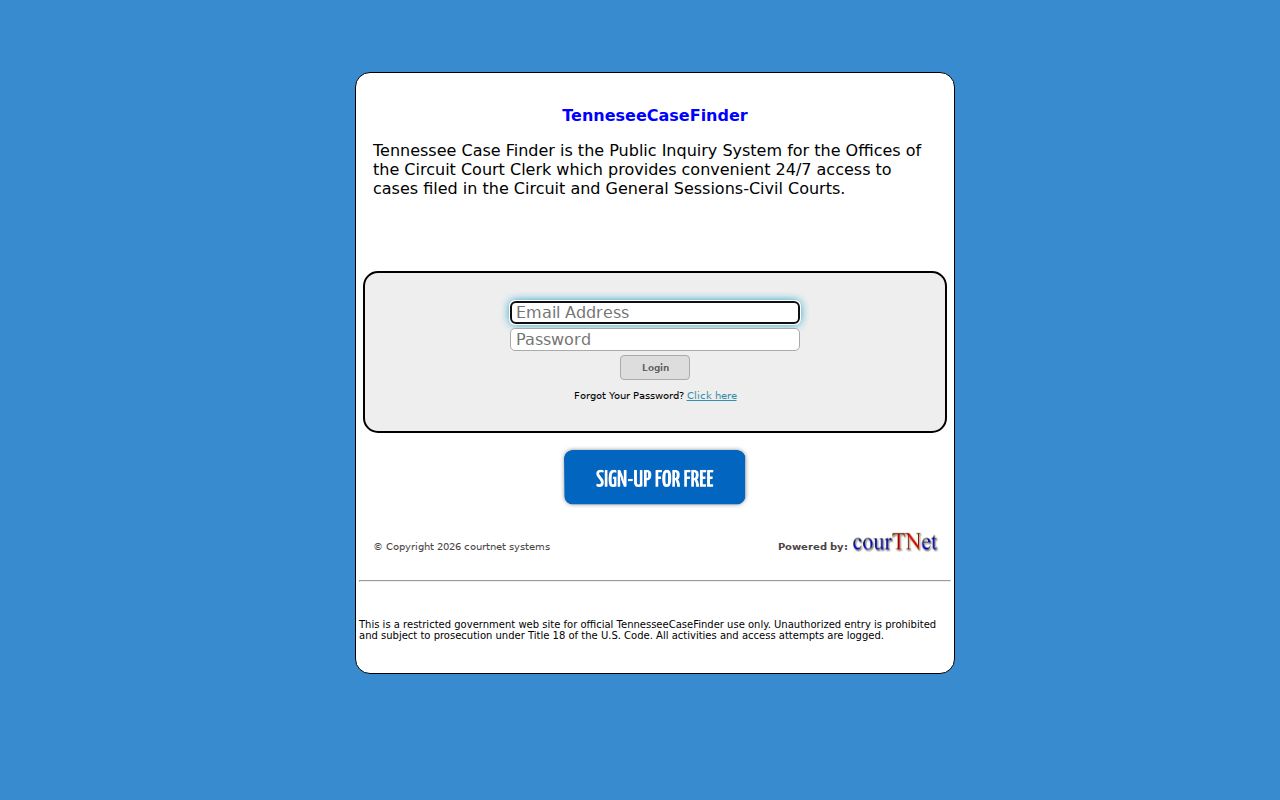
When CourtNet stops at login, go back to Henderson's office. Phone, counter, and mail all work for a docket request. A confirmed office email does too. Tennessee Public Case History helps only if a case reached an appellate court.
Note: A restricted CourtNet page is not proof. It does not mean a Marion criminal docket is sealed or absent.
What a Criminal Docket Shows
A Marion County criminal docket lines up procedural facts in fields. Need a field pattern? The official AOC Criminal Individual Case Listing is a useful model. Its June 2023 report aggregates cases. It does not search live people. Read several fields together, since a status without its disposition date can mislead. A disposition label without the signed judgment may skip terms that matter.
| Docket number | The court locator, shown with filing date and location code; preserve the exact form as the clerk records it. |
|---|---|
| Charge and count | The alleged offense classification and each separately listed count. |
| Setting | The hearing type, date, judge, and court event reflected in the case history. |
| Filing type | How the criminal matter entered the reporting system. |
| Disposition | The disposition date and manner, checked against the signed order. |
| Status or seal marker | A pending, disposed, or restricted indicator; it does not disclose every document. |
Further entries may name counsel, motions, fines, costs, and document links. Still, a public docket is only an index and timeline. The charging instrument, plea papers, judgment, or sentencing order sits behind it in the court file.
Marion Criminal Report Terms
Short labels save space in a report, but they can hide real differences. Readers of a Marion County criminal docket should never expand a code by guesswork. The AOC report and the clerk's current legend control what each code means.
- J/C
- A hearing-type code observed in the AOC criminal report. Confirm the report legend before assigning a longer meaning.
- Nolle prosequi
- A prosecution-ending entry that is not an acquittal after trial.
- Diversion
- An authorized disposition path that may affect later expungement eligibility.
- Disposition
- The recorded outcome or closing action for a case or count.
- Sealed
- A restriction imposed by law or court order; the public view may show little or nothing.
Dismissal, guilty plea as charged, plea to a lesser offense, transfer, remand, and diversion are distinct outcomes. The date shows when an event was recorded. It does not recite the full judgment.
Stages on a Criminal Docket
Entries pile up as a case moves. A Marion County criminal docket may open with a citation. A warrant-related filing works too. So does another charging paper. General Sessions often handles the early misdemeanor or preliminary felony stage. A felony may then move through grand-jury and Circuit Court work. Not every case touches every step. One reset can add several setting entries without resolving the charge.
Docket flow: Filing › Arraignment › Pretrial › Plea or Trial › Disposition › Sentencing
Arraignment covers the charge and plea stage. Pretrial entries may track motions, discovery, continuances, or plea talks. A plea or trial leads to disposition. Sentencing may come later. Read the whole sequence, because one setting is not the entire Marion County criminal docket.
Marion Criminal Cases by Count
The FY2023 AOC report offers local context, not a current docket or forecast. Marion reported 201 drug-category dispositions and 81 other motor-vehicle dispositions. It also listed 70 other dispositions. Another 52 were offenses against administration of government, and 31 were offenses against family or person. Rounding out the count were 27 other property matters and 27 other public-welfare matters. There were also 23 DUI matters, seven homicide matters, and three kidnapping matters.
Inside the drug category, the report recorded 94 dismissals or nolle prosequi outcomes. It counted 76 guilty pleas as charged, plus 26 pleas to a lesser offense. It also counted four diversion matters and one transfer or remand. These are dated, categorized dispositions. They cannot predict how any pending Marion County criminal docket will end. Nor can they say how long it will run.
Which Court Holds Criminal Dockets
Two courts split the criminal work in Marion County. General Sessions handles misdemeanors, county and THP citations, and preliminary matters on the criminal docket. Circuit Court takes the felony cases and the broader trial docket. Either way, the paperwork starts with Circuit Court Clerk Lonna Henderson. Her office can tell you which court holds your case, and the official county court page lists her contact routing along with the General Sessions Judge.
Some matters sit outside these two courts entirely. A city ordinance, parking, or traffic case may stay with the municipality that wrote the ticket. Juvenile delinquency runs through a restricted Juvenile Court, not a public adult criminal docket. Federal charges belong to PACER or the Eastern District clerk. Marion County cannot search those for you.
Marion also shares Tennessee's Twelfth Judicial District with Bledsoe, Franklin, Grundy, Rhea, and Sequatchie Counties. So trust the court name printed on your notice. Guessing from the charge alone can send you to the wrong clerk.
Docket Entry or Signed Judgment
A docket entry and the filed judgment answer two different questions. The Marion County criminal docket tells you that a plea, order, or sentencing event happened. The filed paper itself gives the court's actual terms. For a final result, ask Henderson's office. Request the specific judgment or order instead of trusting a short status label.
| Source | Best use | Limit |
|---|---|---|
| Criminal docket sheet | Follow dates, settings, entries, and status | Summarizes each filing |
| Signed judgment or order | Read the judge's ruling and terms | Obtained from the file custodian |
| Certified copy | Obtain clerk authentication | May carry copy and certification charges |
When you request a copy, ask whether the page is public, imaged, redacted, or counter-only. A certified copy must come from the clerk holding the original file.
Marion Criminal Dates Need Confirmation
Marion County's online calendar lists public events and meetings. It is not a verified daily court list. For a Marion County criminal docket date, work from the filed notice or order, then confirm the current setting with the responsible clerk. That step matters most after a continuance, a reset, bad weather, or a courtroom switch.
Confirm the setting: Call the clerk when a notice and a remembered date differ. Ask for the date, time, court, setting type, location, and appearance requirement.
Warrant questions and upcoming criminal settings belong with the clerk too, not a general events calendar. Keep the date from the latest filed notice. Jot down when the office confirmed it.
Public Access and Sealed Criminal Dockets
What a search screen shows does not decide access; court rules and state law do. Under Tennessee Supreme Court Rule 34, case records are public while sealed records, judicial drafts, internal case-management material, and other confidential content stay protected. Tennessee citizens can also file through the Tennessee Public Records Act. That process carries its own legal exceptions and custodian procedures.
Key rules:
Tenn. Code Ann. § 10-7-503 generally provides Tennessee-citizen inspection rights, subject to exceptions and custodian rules.
Tenn. Code Ann. § 37-1-154 limits access to juvenile records.
Tenn. Code Ann. § 40-32-101 and AOC guidance govern eligible expungement routes through the originating court.
A search that turns up nothing may mean sealing, expungement, juvenile status, redaction, an older unindexed file, or a portal limit. Ask the clerk for any non-confidential portion and the legal basis for any denial. Do not rebuild protected information from third-party sites.
Note: Expungement is a court process. An empty search result alone does not prove a Marion record was expunged.